By DEBRA HAIGHT
BCR Correspondent
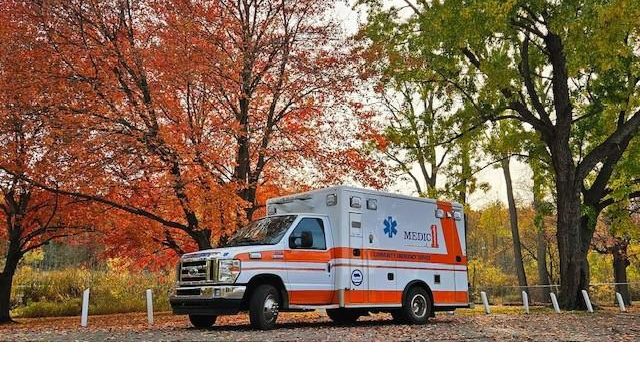
NILES, MI – Area leaders received an update last week on the proposed merger of the county’s two ambulance services. The consultant hired by Medic 1 and the Southwestern Michigan Community Ambulance Service presented his findings supporting the potential merger at meetings in St. Joseph and Niles.
Community meetings were held March 16 at Corewell Health in St. Joseph and the following day, March 17, at the Niles City Council chambers in Niles. Each meeting was attended mainly by local governmental leaders and ambulance staff.
The two ambulance services have been talking about a possible merger for the last few years and hired a consultant in early 2025. That consultant, Matt Zavadsky, has many years of experience in the emergency services field and met with area leaders here over the last several months in preparing his report.
That report, entitled “One System, Greater Impact: The Case for EMS Consolidation”, highlighted what’s going on in the industry both nationally and here in Berrien County. He noted that ambulance services across the country are facing unprecedented fiscal challenges due to skyrocketing costs, staffing challenges and stagnant fee for service revenue.
Zavadsky began his presentation by calling both services “excellent” and saying residents are blessed to have them. Having said that, he said he found a number of areas where the services can improve when it comes to billing and staffing and that their outlook could be improved dramatically if they merge into one larger organization and achieve efficiencies.
He pointed out that when fee for service revenue doesn’t cover the costs for service at desired levels, local subsidies are required. He added that the primary cost drivers are response times, fixed versus flexible production strategies, and deploying Advanced Life Support (ALS) services when only Basic Life Support (BLS) services are needed.
He urged the services to raise their rates to insurance companies to gain more revenue and to also change how they deliver services. He pointed out that only a small portion of calls require advanced life support services and can be handled by people who are not paramedics, which would free paramedics to answer the calls where they’re most needed.
He noted that Medic 1 has already partially acted on raising rates charged to insurance companies for ambulance runs above what Medicare and Medicaid traditionally have reimbursed. He said that several states have begun charging insurance companies at multiples of three or four times the Medicare reimbursement rate.
Other general recommendations he made included realigning response time goals as only five percent of 9-1-1 calls are for time sensitive emergencies, instituting tiered deployment of ALS and BLS ambulances as many 9-1-1 calls don’t need the ALS services, and bidding out their billing services.
He went over the benefits of a Medic 1 and SMCAS merger including clinical, operational and financial sustainability. He said the two services can achieve operational efficiencies, stabilize their finances and strengthen clinical quality by merging. Staffing and equipment resources could be consolidated and strengthen both services’ outlook for the future.
He acknowledged that merging the operation side of the two services will be “much easier” than merging their governance. Currently each service is operated by boards made up of local municipal leaders.
“You can’t just combine the boards but find a new way to govern,” he said. “You need to decide in your communities how you want to merge and create a new identity. This needs to be a community conversation.”
Oronoko Township Supervisor Mike Hildebrand was among those in agreement. “This has gotten us to the point of what needs to be done. The next step is the how,” he said.
He asked Zavadsky if he was available to consult on the how and got an affirmative answer. “It will be good to have a tour guide,” Hildebrand then said. “It takes heat off some of the conversation that needs to happen if we have someone to hold our hand as we go along.”
Questions came in a number of areas at last week’s meeting in Niles. Ambulance staff in attendance were concerned about staffing and duties, while government leaders wondered about response times and funding. More than one local leader asked if the services could partner without a full merger.
“We are in a time when our people need to realize that the service has a need that has to be filled whether that’s a merger or a partnership,” Howard Township Supervisor and SMCAS Board Chairman Bill Kasprzak said. “If we don’t work together, we won’t have a service at all.”
After the meeting, SMCAS Executive Director Brian Scribner said that he and Medic 1 Executive Director Jason Wiley will next seek formal approval from their boards to hire Zavadsky to help them take the next steps including guiding the design and implementation of the new system.
“Funding mechanisms will be one of the key items we need to determine moving forward,” Scribner said. “The consultant’s work shows that the tax burden on our communities can be reduced under the new model, provided the right steps are taken and a well‑designed system is built.”
He said that any changes—including the possibility of a new millage—will be evaluated as part of the process moving forward.
When asked about concerns that people are expecting to get ALS service when that might not be the case in all instances, Scribner said the new model is intended to improve the delivery of ALS care for anyone who needs it.
“While it may look different from today’s structure, it will ensure that residents receive high‑quality care on every call, with advanced life support delivered more effectively when it’s required,” he said. “The system is being built to send the right resource to the right call, with the goal of having ALS available whenever it is truly needed.”