

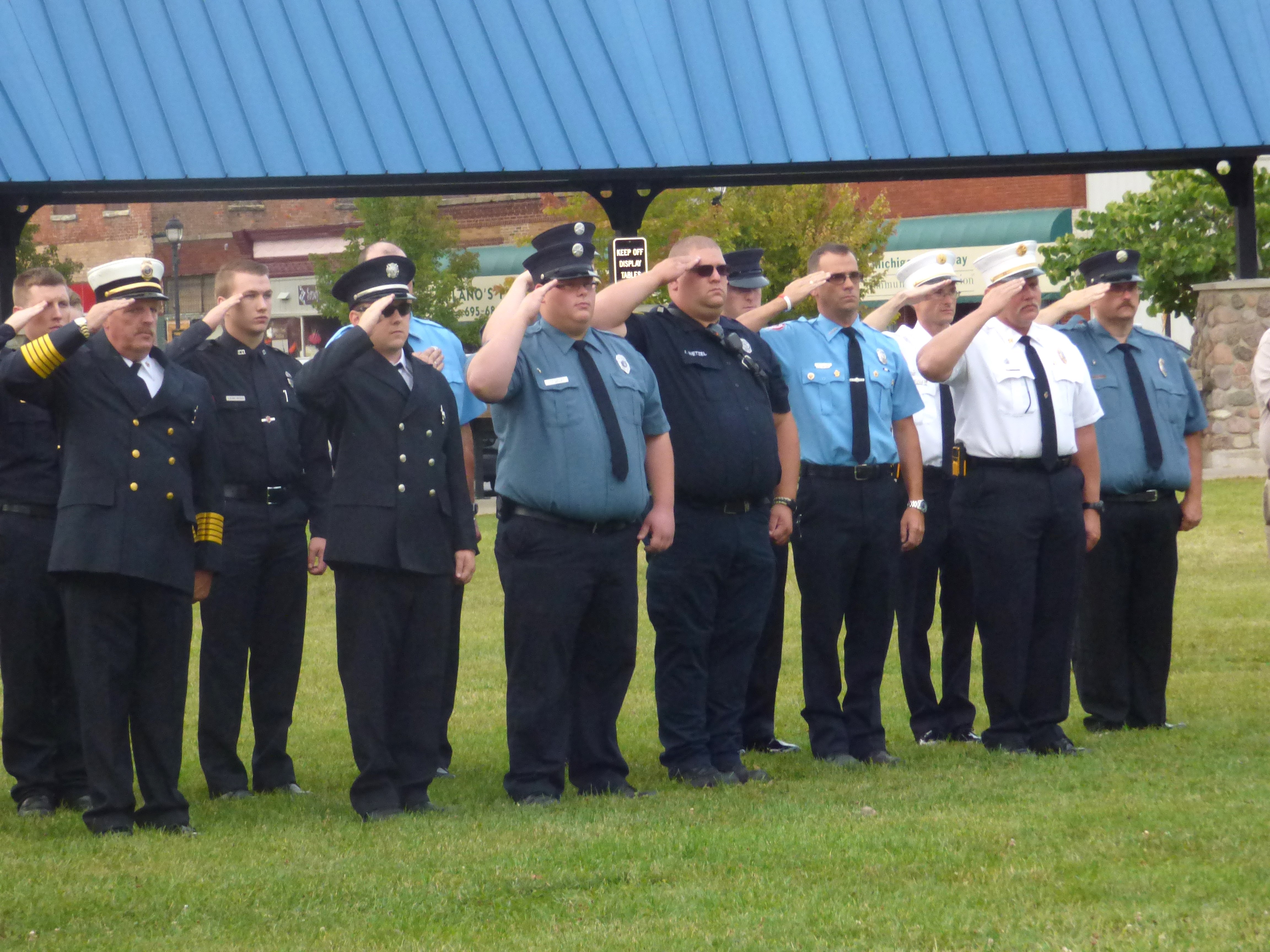
 BUCHANAN – It’s been 16 years since the Sept. 11, 2001 terrorist attacks on the nation and the city of Buchanan has continued its tradition this week of holding an annual Patriot Day commemoration.
The attacks drew the nation together as people prayed for those who died and those who survived. Several area ministers and law enforcement officers traveled to New York City in the weeks after the attacks to lend their assistance to the recovery effort.
This year’s event was held Monday, Sept. 11 at 7 p.m. at the Buchanan Common. The service featured music from the Buchanan High School Band and remarks by Mayor Brenda Hess, Sheriff Paul Bailey, SMCAS Director Brian Scribner and representatives of State Sen. John Proos and U.S. Rep. Fred Upton.
The event is sponsored each year by the city of Buchanan, the Buchanan Area Ministerial Association and the Buchanan American Legion. Area police and fire departments also participate each year. This year, donations were accepted for the hurricane relief effort.
The Sept. 11 anniversary has special meaning for Buchanan resident Monroe Lemay. She lived in New York City at the time and worked just blocks away from the World Trade Center.
“It’s not something that leaves me, I think of it every day,” she said last week. “It was a trauma that doesn’t leave me. It’s like how people remember where they were when John F. Kennedy was killed … I always communicate on Sept. 11 with those I was with that day. It’s a bond that we have.”
“Every year it becomes a little more substantial to me, I still have a hard time watching the footage on television,” she added. “I was there, but I really didn’t see all of the footage of the planes going into the towers and the towers falling until a year later. Looking at the footage was actually more intense than being there.”
Lemay moved back to Buchanan six months after the attacks to be with her mother after her father died in the fall of 2001 and is now the director of the Buchanan Area Senior Center.
Lemay said that day in 2001 started out like any other normal late summer day but soon became something much different. “I managed a restaurant under the Brooklyn Bridge as well as an art gallery next door to it,” she said. “I felt the first impact of the first plane hitting one of the towers and thought it was a truck nearby.”
“I didn’t hear or see anything at first but then the sirens got really loud and didn’t stop coming across the bridge. I had only heard that once before at the time of the first World Trade Center attack in 1993. I was talking to an artist and said something was going on. He said to turn on the tv and I saw the second plane going into the towers.”
She had no doubt even at that point that it was a terrorist attack. “After having grown up in Israel, I knew it was a terrorist attack,” she said. “I started running toward the World Trade Center. I got to City Hall and the only thing I could hear was the rumble and the smoke rising up. There was glass and metal in the air and it was in my hair and on my arms.”
Lemay’s first concern was the fate of her sister who worked on the 73rd floor in Tower One. It would be four hours before she got word that her sister had made it out.
“Around 1 p.m. that day I said I had to register her name and see if I could find out anything,” she said. “The owner of the restaurant where I worked told me to check my answering machine first. I had 23 messages from people asking if I was alright and the 22nd message was from my sister. She had made it out alive.”
Lemay said it was a surreal time to be in the city. People stayed outside and were afraid to go to sleep for the first few days. “You felt like you were in a war zone,” she said. “People thought we’d continue to be hit. Nobody went to sleep, everybody was outdoors. People started cooking all the food they had and giving it to first responders.”
“We were working on adrenalin. Everybody was doing what they could do, there were no strangers … When the police came and said they had to check the roofs of our buildings for body parts, I collapsed and started crying and two officers sat with me and were crying too. Every few minutes people were breaking down and others would come and hug them.”
“For a week or so, everyone was united. The world changed that day, Americans never realized that this could happen here … It was a very patriotic time, we would greet every firefighter and police officer we saw. There were flags all around after that day. New York City was the friendliest it ever was.”
One of the most heartbreaking scenes for her was walking by the fences around local hospitals. “”They were all covered with pictures of missing people,” she said. “There were miles of gates packed with photos. It was heartbreaking. The first day I was mesmerized but as the days went by came the realization that they didn’t make it out.”
Lemay noted that the events of that day affected everyone differently with many like her suffering from post traumatic stress disorder. She first got help a year afterwards when she attended a class on coping with loss led by Dr. Harvey Burnett, a counselor and Buchanan Police Department sergeant.
“It brought a tremendous amount of uncertainly and loss of hope,” she said. “You’d either become a believer or not. For me, I believed again. I was looking for someone to hold on to and I became closer to God.”
Leave a Reply
You must be logged in to post a comment.