
By DEBRA HAIGHT
BCR Correspondent
ST. JOSEPH, MI – Berrien County Commissioners gave their stamp of approval last week to a new type of financing for residential developments. It was the second time since August that commissioners approved a residential brownfield redevelopment plan.
The new tool available for certain residential developments is the result of a 2023 change to the brownfield redevelopment authority law that expands what types of developments can use tax increment financing tools for funding.
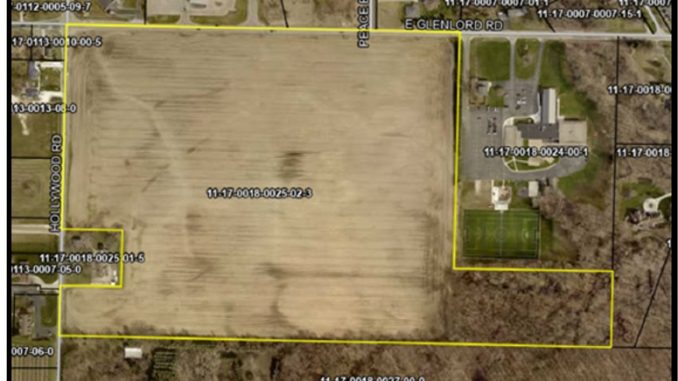
The proposed $39 million brownfield redevelopment plan approved by the county board will be located on a site in Royalton Township near St. Joseph. Specifically, the site is at the corner of Hollywood and Glenlord Roads and is currently farm land owned by John Nye. The land is next door to a Lutheran church and across the street from a grocery store.
Berrien County Community Development Director Dan Fette told commissioners that the developer is Allen Edwin Homes. It is a regional company that is behind a number of area developments including one in Watervliet that is also using the new brownfield redevelopment tools.
While the Watervliet project is on a smaller piece of land, just 7.5 acres, and will be home to 19 homes, the Royalton Township project is 54-acre site that will be home to 120 single family homes. In both instances, the developer has agreed to set aside some homes for low income residents.
As he had in August, Fette said that the changes in the brownfield law have opened up redevelopment tools to housing developers rather than just commercial and industrial developers. Properties no longer have to be blighted, tax reverted, contaminated or obsolete, he said.
He said that a number of housing activities including rent subsidies as well as private and public infrastructure necessary to support the developments can be considered eligible costs that can be included in a reimbursement schedule under a tax increment financing (TIF) plan.
“Housing projects that align with local needs assessment and reserve a certain number of units for income qualified people can be included in the brownfield plan, and then the housing subsidy activities and infrastructure costs can be eligible for reimbursement under the TIF plan,” he said.
With the Royalton project, it’s been estimated that the developer could receive potential reimbursement of $19 million over 25 years. The total cost for the project is estimated to be $39 million with work starting still this fall and continuing through 2032. No public funds are expected to be used in the project.
Fette said the Watervliet and Royalton projects (as well as two more expected to come before the county board in coming months) align with market studies showing the need for affordable housing in Berrien County. The two new projects that will come to the county board are also in the St. Joseph area.
“There have been multiple studies both statewide, regional and local indicating there’s a need for more housing in Berrien County,” he said. “According to the Southwest Michigan Planning Commission’s housing diagnosis tool, there’s an estimated 23,000 housing units needed to meet the demand in Berrien County.”
“There’s also a strong need for missing middle housing for households earning between $50,000 and $100,000 a year,” he added. “That’s about 2,900 units needed there … About 44 percent of households in this area are burdened by cost, meaning they’re having a difficult time finding rental units that meet their income levels.”
On questioning from Commissioner Teri Freehling, Fette noted that these projects are aligned with local master plans and future land use plans. “We don’t want to present plans contrary to the wishes of residents,” he said.
“The second point is as a practical matter for cost, it’s going to be the case that these projects will be located approximate to urban uses because the infrastructure is already in place,” he added. “It’s very unlikely see project build in middle of corn field where there is no infrastructure.”
For her part, Freehling asked fellow commissioners to continue to be mindful of keeping the area’s agricultural heritage. “My question going forward is we need to be mindful of land use because we’re not making more dirt at any point in time,” she said.
“From a farming perspective, the agriculture industry wants to be very mindful of land we’re taking out of production of agriculture versus what purpose the land is being used for,” she added.