

By DEBRA HAIGHT
BCR Correspondent
Public transportation in Berrien County could be changing in coming years with fixed routes established including one from the Twin Cities to Niles and South Bend. Connect Berrien representatives presented the proposed plan for the new countywide system at public forums last week.
The plan being presented now is the culmination of work done over the last several years including a comprehensive study completed over the last year and a half. Connect Berrien representatives now plan to go to local municipalities and organizations to sell the plan to the public.
Their message is that much improved public transportation services can be provided with a minimal countywide millage. While some county residents would pay a transportation millage for the first time, those in Benton Harbor, Buchanan and Niles will likely pay less than they do now with their Dial-A-Ride millages.
The cost of the new plan is expected to be $6.3 million a year as compared to the $4.3 million being spent on the current public transportation in the county. The extra $2 million needed could come from a number of sources including additional funding from the state, a countywide millage and donations from private employers.
Those making presentations last week at locations around the county were Pat Brandstatter of the Strategic Leadership Council and Paul Jewel and Greg Strangeways of 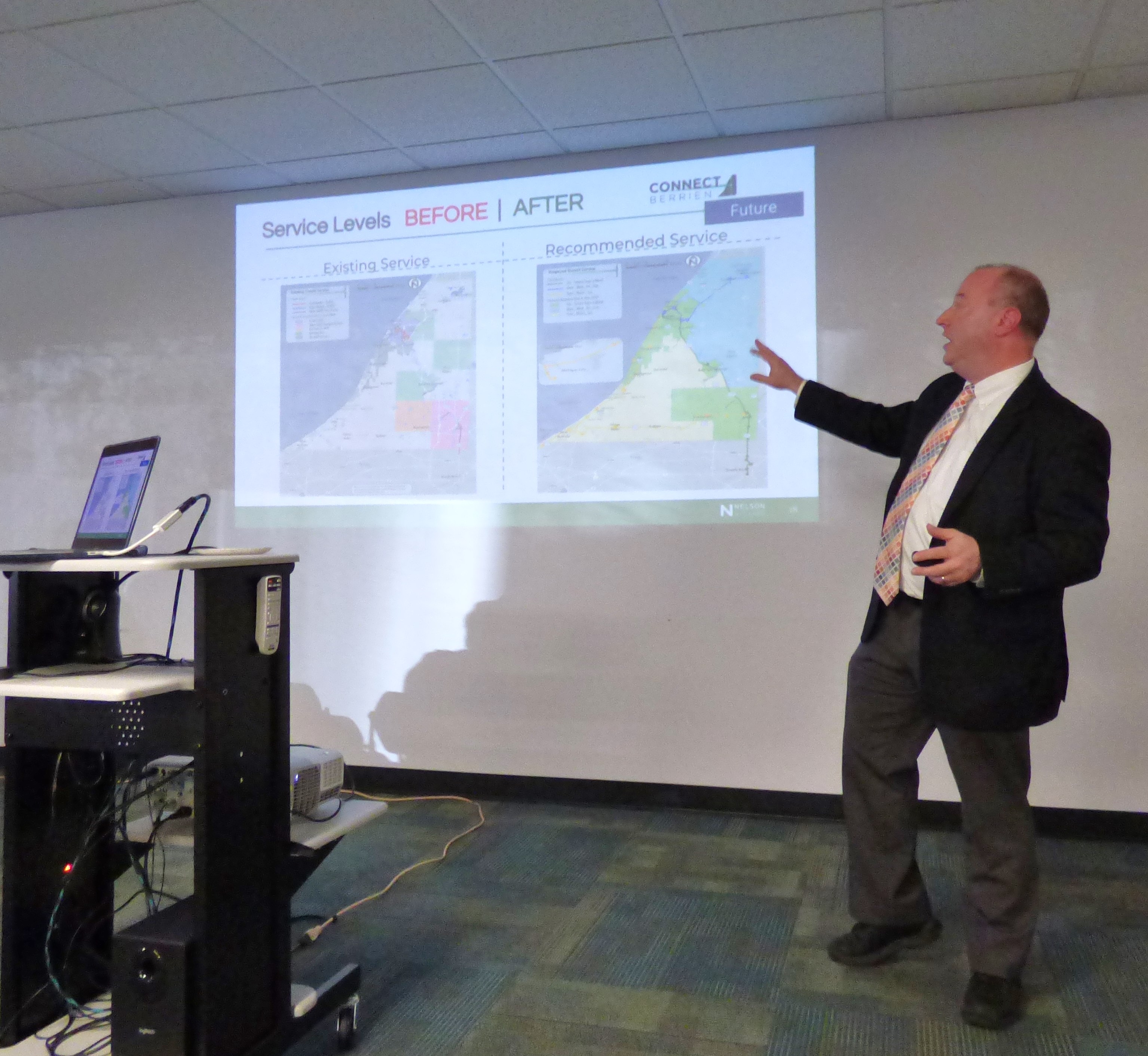 the Nelson-Nygaard consulting firm. Nelson-Nygaard conducted studies and worked with the Strategic Leadership Council and Connect Berrien to develop the final report.
The three men spoke about both the need for a new countywide public transportation system and the proposed solution. They noted that that the county is currently served by four independent services: Berrien Bus, Buchanan Dial-A-Ride, Niles Dial-A-Ride and the Twin Cities Area Transit Authority.
They said that while those four organizations provide public transportation services, many people in the county are still underserved. Those underserved include students and workers as well as people taking public transportation to get to the grocery store and doctor and other appointments.
The solution they’re putting forward would consolidate the four organizations with existing Dial-A-Ride services continuing in the Twin Cities, Buchanan, Niles and the central county area. Fixed routes between the Twin Cities and Niles, the Twin Cities and Coloma-Watervliet, the Twin Cities and New Buffalo and New Buffalo and Niles would be added.
The fixed route service between the Twin Cities and Niles would run seven days a week, while routes between the Twin Cities and Coloma/Watervliet would run four days a week and routes between the Twin Cities and New Buffalo as well as between New Buffalo and Niles would run three days a week.
Strangeways said the proposal offers longer hours of service on weekdays, expanded weekend service including Sundays and the opportunity for people in underserved areas on the north and southwest corners of the county to actually get service. In addition, they believe the fares would be more affordable than they are now.
Jewel said the new plan would serve the entire county with expanded days and locations, have simpler, lower fares and be a more efficient use of current resources. “No new major capital expenditures would be needed,” he said. “We want this to be the vision and template for moving forward.”
Brandstatter said if implemented, the new plan will help everyone in the county as well as promote economic development opportunities. “If this works and we can get everyone to say it’s worthwhile, I think we can get people to support a millage,” he said. “… This is not a silver bullet, but we can’t start running until we start walking.”
“This is the beginning, it’s about mobility in Berrien County,” he added. “Employers say they are willing to put private money in and to recruit new businesses, we have to work collectively. Can we afford not to do this? … Let’s be successful in the longterm and not get caught up in the small battles.”
Concerns raised at the meeting last week in Niles included questions about whether customers of existing Dial-A-Rides would see services decline-which the speakers denied and what will happen to the existing Dial-A-Ride organizations.
Officials with the Twin Cities Area Transportation Authority have been skeptical of the new plan. They are the largest public transportation service in the county and are concerned about the consolidation effort and what would happen to them.
“That’s the $64 million question, there’s a lot of concern over who’s going to fund it and operate it, they don’t want to lose their own service,” Jewel said. “We’re trying to come up with a common vision first. The decision to consolidate won’t be easy but then we have to find a way to fund it.”
He noted that similar type public transportation millages have passed in other parts of the country as people found what would work for them.
Leave a Reply
You must be logged in to post a comment.