

By: Stan Maddux
Boy Scouts of America members from southwest Michigan and northern Indiana are receiving protection against tornadoes and other severe weather by members of the U.S. Marine Corps. Reserves out of South Bend.
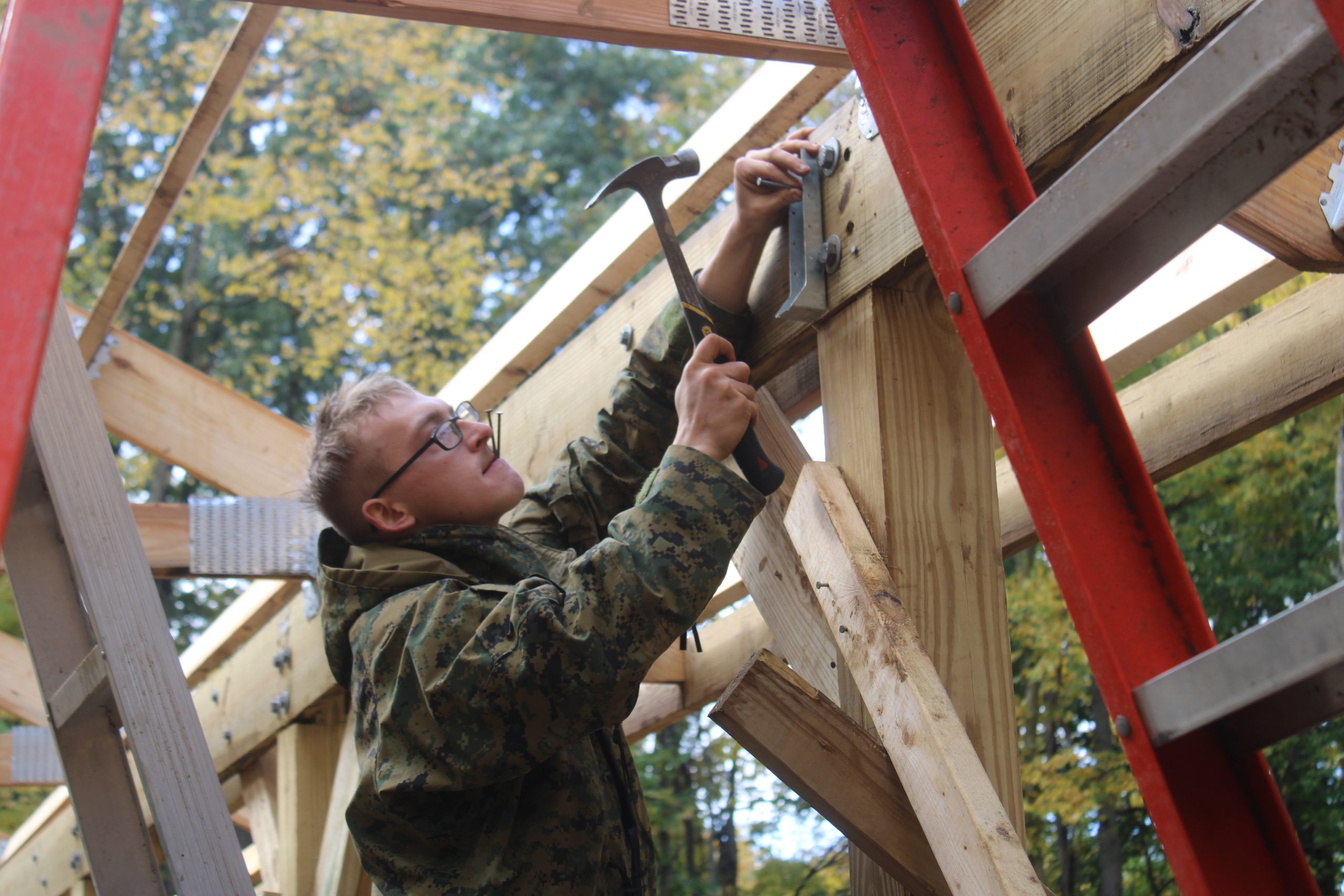
The reservists are constructing three storm shelters at Camp Topenebee near Michigan City, Ind. at the request of the LaSalle Council of the Boy Scouts of America.
The LaSalle Council represents boy scouts from Berrien and Cass counties in Michigan along with St. Joseph, Elkhart, LaPorte, Marshall, Starke and Porter counties in Indiana.
Two of the storm shelters are nearly finished while the other one should be completed before the end of the year, said Chief Warrants Officer Jacob Friddle, a member of the armed forces reserve center at 1901 Kemble Ave.
Friddle resides in Nashville, Michigan about 30 miles north of Battle Creek.
He said the floors, walls and ceilings in the storm shelters below the ground are made of concrete.
Each shelter measuring about 1,000 square feet has a walk in basement for easy access and two separate exits along with restrooms.
Friddle said the construction meets U.S. Federal Emergency Management Agency standards.
The shelters at different locations at Camp Topenebee are for boy scouts with the South Bend based LaSalle Council, which covers eight counties across northern Indiana and southwest Michigan.
Until now, the boy scouts using the 166 acre grounds during the summer for camps and other related activities had only a training facility to take cover during severe weather, said Ken Coleman, the caretaker of Camp Topenebee owned by the LaSalle Council.
Coleman said the wood framed, rock sided building is solid, but still vulnerable to damage in a bad storm from being above the ground and having windows.
Windows could break during a tornado, for example, and result in major injuries from flying glass.
“It’s a strong building. It’s just on top of a hill, not ideal for storm location,” he said.
Directly above each storm shelter is an open sided, wood framed pavilion with a pitched roof for boy scouts to take part in programs.
Coleman said each pavilion is wired for electricity to have lights for activities in the evening and night.
Construction started about 18 months ago when the LaSalle Council reached out to the marine reserve base to gauge their interest in building the structures.
Coleman said the last time the LaSalle Council asked the marine reservists for help was in the 1990’s for constructing an over two mile long fitness trail at Camp Topenebee founded in 1948.
“We just made that reconnection with them when we started the storm shelter process to see if they were interested,” he said.
Friddle said the unit jumped at the opportunity because it was a chance for the marine reserves to sharpen their military related construction skills.
“It met our training needs,” he said.
After joining the military, Friddle said all of the reservists in South Bend were taught how to move dirt with heavy machinery and given other skills in areas such as carpentry and running electricity.
The purpose was to give them the ability to clear terrain for creating makeshift roads for trucks to reach camps with food and other supplies during combat.
They also learned to quickly dig bunkers for protection against enemy fire and build above ground shelters with power as fast as possible for troops to have at least a minimal quality of life.
That process was repeated whenever troops moved to another combat related location.
“The type of structures depends on what we have time for and what’s needed,” Friddle said.
He said all of the 120 or so reservists at the base have taken part in the storm shelter construction.
Coleman said the construction has occurred mostly when the reservists are available on weekends but there was a nine day stretch last summer where the work was continuous.
“We’ve worked with their drill schedule in order to get this done,” he said.
Leave a Reply
You must be logged in to post a comment.