

Story & Photo Credit: Greenville, MI Daily News and Reporter Elisabeth Waldon
ELISABETH WALDON ewaldon@thedailynews.cc
LANSING — The Michigan House Government Operations Committee on Tuesday took up a 106-bill package (House Bills 6334-6440) which would substantially change the way public notices are published in newspapers. “It’s not a typo. It’s that many bills,” noted Rep. Jason Sheppard, R-Temperance, who is chairman of the committee. The main bill (HB 6440) was voted out of committee on Tuesday but fell short of Michigan House votes needed to pass it off the floor on Wednesday, so the voting board was closed and the proposed bills were placed back on the calendar to be addressed again at a future date. Local state Rep. Jim Lower, R-Eureka Township, and Rep. Julie Calley, R-Portland, both voted “no” to HB 6440 on Wednesday, while Rep. Thomas Albert, R-Lowell, voted “yes.” The Michigan Press Association has been working on alternative legislation for consideration in coordination with Lower.
The current 106-bill package is sponsored by Rep. Steve Johnson, R-Wayland, and Rep. Kevin Coleman, D-Westland, both of whom appeared to testify before the House Government Operations Committee on Tuesday — as did multiple newspaper officials, all of whom voiced concerns about the bills and urged reconsideration.
“One of my local township clerks said our local weekly newspaper that we all used to get stopped going out,”
Johnson explained of his reasoning for sponsoring the bills. “When we do a notice, we’re putting it in another paper that no one in our area reads. We’re trying to work on a better solution. It’s not perfect but it’s pretty good.” Johnson said the proposed bills would require local government bodies to post notices on a website as well s to archive them in a database. Local government bodies would still be required to send notices to all local media (newspapers, radio and TV) — but the government bodies would not be required to pay if the media publishes the notice. Local government bodies would also be required to oversee an email subscription option for anyone who wants to receive the notices via email, as well as to send notices via first-class mail to anyone who requests them (with a fee not to exceed printing and mailing costs).
Both Coleman and Johnson said the bills would increase transparency, but Committee Vice Chairperson Rep. Christine Greig, D-Farmington Hills, questioned this claim.
“You say most people get it this way, most people use online. But in a democracy it’s supposed to be about all the people having access to it,” Greig said. “What about the residents who don’t use email, don’t use the internet and go through the newspapers for their source?
“There are a lot of folks that love that newspaper. A lot of seniors in particular,” she said. “There are people who read those notices. We’re actually going to be charging people for this (with the proposed bills) because they haven’t gotten on board with technology because maybe they’re 90 years old.”
“I think you make some good points but in a city like mine, there’s almost zero circulation for the newspaper that we used to put things in,” Coleman responded.
“In my community, we don’t have a local paper anymore,” Johnson added. “People are buying a paper that’s out of the district essentially. There are libraries with computer capability. There will still be notices posted at City Hall.”
“I think the concern is it’s an option for local governments, it’s not an option for local readers,” said Greig, who has a background in IT and security systems. “Would you agree that most local governments aren’t sophisticated with their IT arrangements? I’m afraid this actually could expose our democracy and expose our transparency (with cybersecurity issues). Local governments don’t have those resources. They absolutely don’t have those resources.”
Greig said more time is needed for designing a proposed new system and determining who will administer and oversee it, how archives and a database will be created and how much it will cost — and then a test is needed to try to “break” the system to make sure it’s working correctly before it’s implemented.
Rep. Yousef Rabhi, D-Ann Arbor, also voiced concerns about language in the proposed bills no longer requiring local government bodies to publish full ordinances in the local newspaper.
“The bill actually restricts what is required to just requiring postage of notice of the ordinance,” he said. “I am concerned about that. It would seem to be that we should still be requiring them to post the full scope of what the law requires. Posting the full language of that ordinance is important.
“I have an iPhone and a computer so I can easily access online resources from the convince of basically everywhere … but I know some people simply can’t afford a cell phone or a computer and don’t have access,” he added. “Not every community has a library where computers are working and now during this pandemic, there’s not always access there as well. I also understand that not everyone can afford to buy a newspaper.”
Greig noted the Michigan Press Association is a check on state and local government and she wondered why they weren’t included more in this proposed legislation. She asked her fellow representatives to work on the bills some more and introduce them again next year with more input.
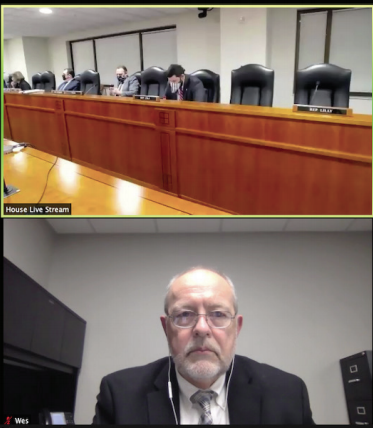 Wes Smith, group publisher of View Newspaper Group which owns the Daily News, testified at Tuesday’s Michigan House Government Operations Committee meeting regarding proposed legislation that would change how public notices are published in newspapers. — DN Photo | Elisabeth Waldon
‘WE HAVE A TRIED AND TRUE SYSTEM THAT WORKS’
Wes Smith, the group publisher for View Newspaper Group — which owns 16 community newspapers, including the Daily News — is a Michigan Press Association board member who was among those testifying via Zoom on Tuesday with concerns about the proposed legislation.
“Our readers are very engaged in the process of self-government,” Smith noted. “Many of our readers attend those local meetings we cover, especially when things aren’t going the way they think they should go. Our readers are informed. Our readers weigh in. Our readers vote. One of the most critical pieces of information we deliver to our readers — through the publication of public notices in our newspapers — is when and where their government officials will be meeting to do the business of the people.
“We have been thanked countless times by both readers as well as our city, village and township clerks for publishing that information,” he said. “On many occasions, our editors and local publishers have heard from citizens who said they would have no idea that a particular zoning board or other government meetings of interest was to take place if they had not read about it in one of our newspapers.
“The current system requiring notice of those meetings through publication in newspapers works,” he said. “It provides transparency, is independent, verifiable and provides a permanent record. It is difficult to see an alternate plan — one that would replace public notices in newspapers with placing those notices on government-owned websites — working as well for the people of Michigan. Given the current lack of uniform and affordable internet access for the families of Michigan, it is hard to see how those families could access the public notices. Given the current state of small city, village and township websites, technology and training, it is hard to see how our local clerks would be able to fulfill their obligation to post those notices. Given the fact that many of our most engaged citizens and voters — those of the Greatest Generation — have neither the technology aptitude nor inclination to go online, let alone navigate the twists and turns of the internet, it is hard to imagine putting into place new rules that would cut them out of the democratic process.
“If online access to public notice is the point of making a change, I submit that online access already exists through our newspaper websites and through the websites of many our fellow Michigan Press Association newspapers,” he noted. “Our association is working hard to make that online access more uniform and easier for readers to access — and we have a considerable head start in doing so, with investment of our own dollars — not the taxpayers’ money.
“I ask you to carefully consider the difference between what we have — a tried and true system that works and is evolving to continue to serve the needs of Michigan citizens — and what is proposed — an unknown, difficult to implement and difficult to access system that likely bears unforeseen costs and complications. I ask you to consider which will keep our readers, our fellow citizens and your constituents more fully engaged in their local government,” Smith concluded.
Michigan Press Association Public Affairs Manager Lisa McGraw cited a recent poll which showed 50% of people seldom or never access their local government website while 20% only access it a few times per year.
“We constantly hear how this is going to save local governments so much money,” McGraw said. “I’ve been asking for 12 years to see those numbers. It costs money to build and maintain a website, along with all the new work those clerks will be required to do.”
Andrew Richner of Clark Hill, a former state legislator himself, called the proposed bills “a massive and complex package of legislation with far-reaching ramifications.”
“The bills essentially throw out nearly 200 years of Michigan jurisprudence,” he said. “The newspaper industry was never asked to weigh on these proposals. In my 25-plus years of experience in Lansing, I’ve never seen anything like this. This is the kind of legislation which begs for a consensus approach with everybody in the room.
“Local government certainly have the option now of posting notices in their website,” he said. “You don’t need a 106-bill package to accomplish this. We ask you to reconsider and not rush this through so we all have a chance to examine this.”
MPA President Richard Lamb, who is the editor of the weekly Presque Isle County Advance, shared that he lives in the 106th District, which was once represented by Rep. Peter Pettalia, who died in a motorcycle accident in 2016. The MPA Sunshine Award was later renamed in Pettalia’s honor as he was an advocate for governmental transparency. “I believe this bill is a threat to open government and I’m sure Mr. Pettalia would think so too,” Lamb said.
Lamb noted that changes can easily be made to meeting minutes, notices and ordinances posted on websites and readers will never know whether the wording is original or was altered at some point. “Not so in a newspaper,” he noted. “Once in ink and paper, it remains there forever.”
Leave a Reply
You must be logged in to post a comment.