

By DEBRA HAIGHT
BCR Correspondent
LANSING – Legislation currently making its way through the Michigan House of Representatives could drastically change how people get information about public meetings and decisions. It could also have a devastating effect on small newspapers both here and around the state at a time when they and other small businesses are already hurting.
House Bill 6440 was introduced by State Rep. Steven Johnson on Nov. 12 as the Local Government Public Notice Act. It actually encompasses over 100 smaller bills and establishes new procedures for public notices by governmental bodies, allowing those notices to be posted on governmental websites or on local media radio or television outlets.
The proposed law would take effect Jan. 1, 2022 if it passes both the House and Senate and is signed by the governor. Newspapers would still be able to post such public notices but business to them would not be guaranteed as governmental bodies would have other choices available to meet public notice requirements.
As of early this week, the legislation is stalled in the State House. House members began voting on it Dec. 2 but voting was halted when Republican leaders didn’t think they had the votes to pass it. Since then, the legislature has not been in session due to COVID concerns.
State representatives from Southwest Michigan have taken differing stands on the legislation. 79th District State Rep. Pauline Wendzel voted
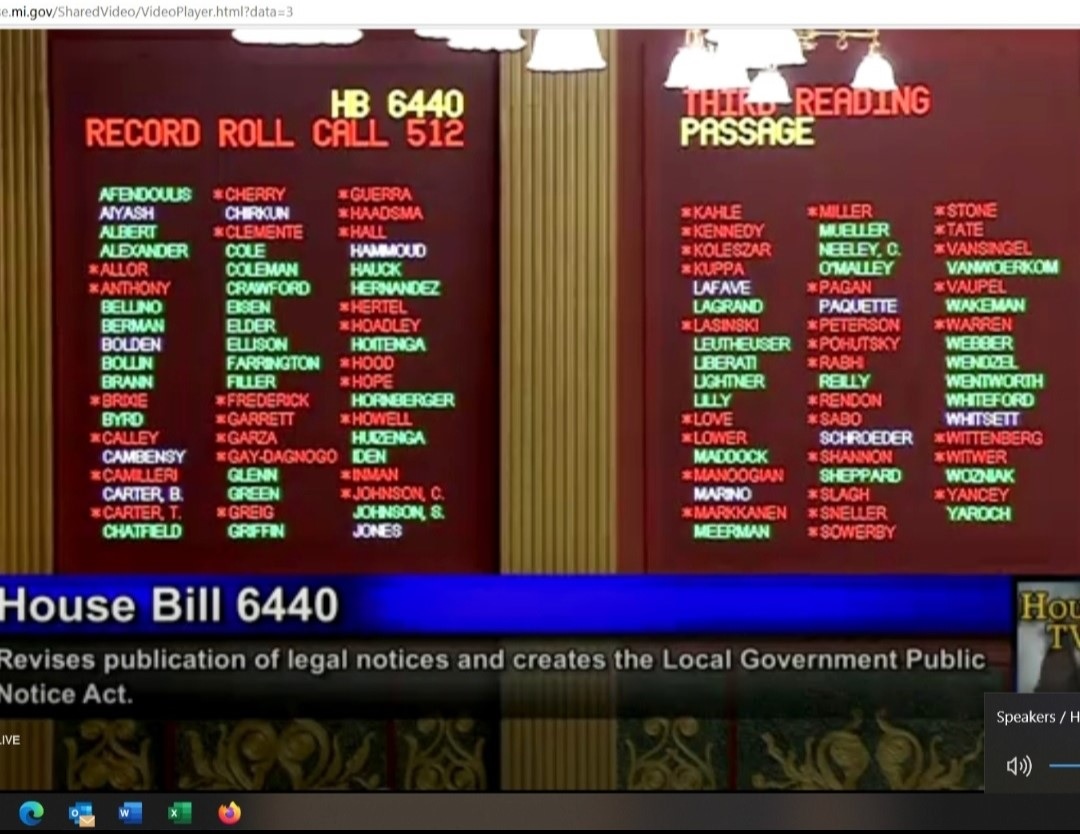
yes, 59th District State Rep. Aaron Miller voted no and 78th District State Rep. Brad Paquette did not vote.

Paquette commented about the legislation but would not say how he will vote if the vote on the bill resumes. He did say he doesn’t expect the legislation to pass. He said he sees the proposal as a way to modernize the public notice process as well as to save governments money.
“Current law demands taxpayer dollars to help pay print costs for notices in newspapers that an increasing majority of locals choose not to receive,” he said. “The bills in question would allow local governments to post their own notices, including online, meaning public notices would be more readily available.”
“By removing the requirement that local governments publish public notices in newspapers, municipalities will save tens of thousands of dollars per year,” he added.
He said that newspapers can continue to keep readers informed of government public notices to provide governmental accountability under the proposed legislation. At the same time, governments who are able to do so can put those notices on their websites and individuals can sign up to receive notices.
His views on governments saving money was echoed in a legislative analysis done by the House Fiscal Agency. The analysis concluded that governmental bodies could potentially save money by not having to pay for notices in newspapers, especially if they already have a working website able to post public notices and archive paper copies of the notices.
The proposal has been met with opposition by most if not all newspapers in the state as well as organizations such as the Michigan Press Association. Their concerns center not only on the financial hit newspapers will take but also on how the proposed legislation could affect people’s right to know what’s going on in government.
Michigan Press Association Public Affairs Manager Lisa McGraw said she’s skeptical that the change in the law will really save local governments any money. “They keep saying that it will save local governments money and I’ve asked them to prove it,” she said in a phone interview last week. “They don’t give me an answer.”
She noted that while organizations such as the Michigan Municipal League and the Michigan Township Association back the proposed legislation, there’s not much evidence that local clerks want it. “I can’t imagine local clerks like this, it will cause them to have so much more to do,” she said.
There’s also the concern that the public wouldn’t be well served by this legislation. She likened it to the fox guarding the hen house with the governmental entity controlling what notices are posted and how and when they’re posted. Transparency and people’s right to know would come out on the losing end, she added.
She pointed out that it isn’t just townships and municipalities in rural areas with website problems, it’s a problem across the state. Even when governmental entities do have their own websites, they’re often out of date and don’t have the most current information.
McGraw said Republicans in the legislature have pushed to kill newspaper notice requirements for 12 straight years. This time around, it’s being pushed in the lameduck session between the November election and the new term in January and has the support of Michigan House Speaker Lee Chatfield who leaves office at the end of the year.
“The scary part is that they’re doing this when no one is looking,” she said. “I’ve said this will hurt the newspaper business and there’s also the question if whether this is something they think is worthy to do during the lameduck when COVID concerns should be the top priority.”
She also questioned why Republicans are the primary ones to push this. As a former Republican staffer in Lansing, she wonders why they support taking away from privatization and business and instead favor something that makes government bigger.
Berrien County Clerk Sharon Tyler has a different take on the issue.

She pushed for the passage of similar legislation during her tenure as a state representative from 2008-2012. She said back then she pushed to change how public notices have to be published at the urging of local government officials who saw it as a cost saver.
“When I had the bill, I was told don’t take on the ‘barrel of ink’,” she said in a phone interview last week. “People were fearful for their next campaign and were scared to turn off the media … When I did it, some newspapers came down hard on me, but I had had some local units ask me to do it because it was a cost concern.”
Right now, she doesn’t think that the proposed legislation is even on the radar for most local clerks. While costs are as big a concern as ever especially with possible revenue cuts, she suspects that most local clerks don’t realize that it’s being debated.
Tyler noted that the publication of public notices is more of an issue at the local level rather than at the county level where she serves now. She said less items have to be published at the county level with the county often meeting the requirements by posting notices on its website.
In her view, this is a tough time to pass this legislation with everyone struggling from the effects of the pandemic. “It really is concerning to see how governments and businesses including newspapers are all struggling,” she said.
Randy Hendrixson, Co-Owner of the Berrien County record adds to this debate “many of the legislators voting in favor of this bill have a flawed view on how public notices are really handled at the municipal level.” “Many of the arguments such as: municipalities will save thousands if they post notices on their websites” is not based on any actual data.”
Hendrixson noted that the Berrien County Record currently publishes a large share of municipal notices in the County of Berrien and the average yearly cost to publish notices (outside of election notices) is less than $500 for the entire year. “Legislators are quick to speak for these municipalities without doing any research or actually talking to the clerks themselves.” “For instance, they (legislators) are making claims that the municipalities will post these notices on their websites and even offer email notifications.” Hendrixson added “This is a pretty steep assumption that municipalities have these resources and capabilities.” When legal notices are published in newspapers, there are layers of processes and people that error check, edit, and format to ensure that the notice is published within a reasonable time frame and is correct. “I think it is unrealistic to think that the average city hall or township could do this work and not add additional costs to their operating budget.” Hendrixson added.
Leave a Reply
You must be logged in to post a comment.